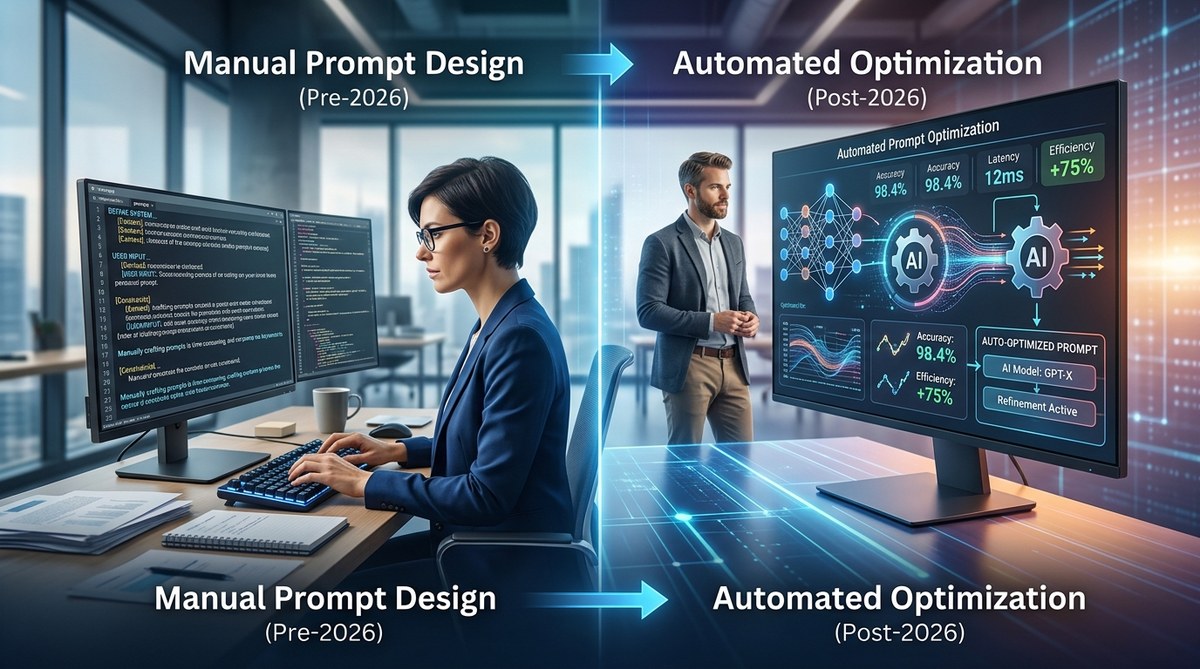
If you are an AI practitioner who still spends hours handcrafting every prompt, you are working way too hard. The era of manually tweaking phrases and hoping for better output is giving way to something far more precise: automatic prompt optimization. In 2026, top teams are letting algorithms, gradient signals, and feedback loops refine their prompts at machine speed. The result? Higher accuracy, less guesswork, and models that actually follow instructions on the first try.
Automatic prompt optimization replaces trial and error with data driven methods. Instead of rewriting prompts by hand, you feed a goal and a dataset into an optimizer. The system tests candidate prompts, evaluates outputs, and selects the best version. This shift cuts development time, improves task performance, and scales across thousands of use cases without manual overhead.
What is automatic prompt optimization?
Automatic prompt optimization uses algorithms to find the most effective text prompt for a given task. Think of it as machine learning applied to the prompt itself. Instead of a human rewriting “be concise” into “provide brief answers” and comparing results, an optimizer runs hundreds or thousands of prompt variations, measures how well each one performs against a labeled dataset, and selects the winner.
This approach works for any LLM, from GPT to Claude to Gemini. The optimizer can change wording, add examples, adjust formatting, or even generate entirely new instructions. The human role shifts from prompt crafter to objective setter. You define the task, supply evaluation data, and let the system run.
Why manual prompt design is fading in 2026
Three forces are driving the shift to automated optimization.
First, scale. A single prompt might work fine for one query, but production systems handle millions. You cannot manually quality check every edge case. Automatic optimization tests across distributions, uncovering weaknesses your eyes would miss.
Second, speed. Manual iteration is slow. Write, test, rewrite, retest. Even a skilled prompt engineer might manage 20 iterations per day. An optimizer can run thousands in minutes. That speed lets teams ship prompt changes faster and iterate on model updates without bottlenecks.
Third, reproducibility. Hand tuned prompts are brittle. A small change in model behavior (a new model version, a temperature tweak) can break them. Automatic optimization bakes in robustness by testing against multiple model snapshots and random seeds.
How automatic optimization works: a practical three step process
-
Define the task and collect ground truth. Start with a clear objective. For example, classify customer emails as support, billing, or general inquiry. Collect a small set of representative inputs and the correct output for each. This is your evaluation dataset. Without it, the optimizer has no signal.
-
Set up the optimizer. Choose a framework or tool that supports prompt optimization. Common options include DSPy, TextGrad, and purpose built platforms like Maester. You provide a base prompt, the dataset, and a metric (accuracy, F1, coherence score). The optimizer then generates candidate prompts, runs them against the LLM, scores results, and selects the best.
-
Validate and deploy. Once the optimizer suggests a winning prompt, test it on a holdout set. Check for regressions. Then push the prompt to production. Some systems even keep optimizing online, using live feedback to adjust prompts over time.
Popular techniques and tools for automatic prompt optimization
-
Gradient based optimization. Tools like TextGrad treat prompts as continuous variables and apply gradient descent. They can suggest rewrites that maximize a loss function. Great for tasks where you can define a differentiable metric.
-
Search based optimization. Frameworks such as DSPy use beam search or evolutionary algorithms. They generate many prompt candidates, score them, and combine the best features into new candidates. Simple and model agnostic.
-
Instruction induction. The optimizer asks an LLM to generate improved instructions based on previous failures. For example, if the model misclassifies a customer email, the optimizer might add “pay attention to the sender’s domain” to the prompt.
-
Example selection. Instead of rewriting instructions, the optimizer chooses the best few shot examples from a pool. This is especially powerful for classification and retrieval tasks.
-
Prompt compression and expansion. Some optimizers shorten unnecessary words or add clarifying context. They balance token cost with performance.
Common mistakes and how automatic optimization fixes them
| Manual Mistake | Why It Happens | How Automatic Optimization Helps |
|---|---|---|
| Vague instructions | Humans assume too much shared context | The optimizer tests many phrasings to find the clearest |
| Overfitting to one example | You tune for a single input | The optimizer evaluates across a dataset, not one case |
| Forgetting edge cases | You cannot think of every scenario | The optimizer samples from real distributions |
| Inconsistent formatting | Different team members write differently | The optimizer enforces a consistent style |
| Token waste | Unnecessary words add cost and noise | The optimizer can trim without losing quality |
Expert advice on adopting automatic optimization
“Stop treating prompts as art. Treat them as hyperparameters. Define a clear evaluation metric, then let the machine find the best configuration. Your job is to design the reward function, not to guess the right words.” Cameron R. Wolfe, Ph.D., researcher in prompt optimization
This shift in mindset is hard for many engineers. We like to feel creative. But the data shows that optimized prompts outperform handcrafted ones in almost every published benchmark. The best prompt engineers in 2026 are those who know how to set up evaluation loops, not those who can craft the perfect turn of phrase.
Getting started with automatic prompt optimization
You do not need a massive budget. Most frameworks are open source and run on a single GPU or even a CPU for smaller models. Here is a path to start today.
- Pick a small task you already struggle with. Maybe a classification task or a summarization job.
- Collect 50 to 100 labeled examples. Quality matters more than quantity.
- Install DSPy or TextGrad. Both have clear tutorials.
- Run a basic optimization loop. Compare the optimizer’s suggested prompt to your current one.
- Measure the improvement. Expect 10 to 30 percent gains in accuracy on first try.
If you want a more guided approach, platforms like Maester offer built in evaluation and optimization workflows. They handle the infrastructure so you can focus on designing tasks.
For a deeper understanding of how prompts affect model behavior, check out our guide on mastering prompt engineering for AI success. It covers the fundamentals that still matter even when automation takes the wheel.
When automation meets human judgment
Automatic optimization does not make human intuition obsolete. You still define the task, choose the metric, and decide when a prompt is good enough. The machine handles the brute force search. This partnership is powerful because it frees you from repetitive trial and error.
Think of it like A/B testing for prompts. Instead of guessing, you run experiments. Instead of arguing over phrasing, you look at the numbers. That is the real evolution in 2026: prompt engineering becomes a science, not a craft.
The road ahead for prompt optimization
We are already seeing optimizers that can adapt prompts to individual users or sessions. Imagine a customer support bot that tunes its greeting tone based on the user’s sentiment history. That is not far off.
Researchers are also working on prompt optimization that respects safety guardrails. The optimizer can test prompts against a red team dataset, ensuring that automated tweaks do not introduce jailbreak risks. This is a critical area for production deployments.
If you want to see how prompt quality affects real world applications, read our article on why prompt quality matters more than model size in 2026. Often a smaller model with an optimized prompt beats a larger model with a generic prompt.
Your next step toward automated workflows
Manual prompt design is not dead for every use case. For one off tasks or rapid prototyping, a handwritten prompt is still fine. But for any project that runs repeatedly, that scales, or that needs consistent quality, automatic optimization is the smarter path.
Try it on a small project this week. Set a timer for one hour. Spend that hour setting up an optimizer instead of manually writing prompts. Compare the results. I suspect you will be surprised by how much better the automated version performs.
When you are ready to go deeper, our tutorial on how to build custom AI agents for your business in 2026 shows how to integrate optimized prompts into agentic workflows. The future of AI development is not about writing the perfect prompt. It is about building systems that find the perfect prompt for you.