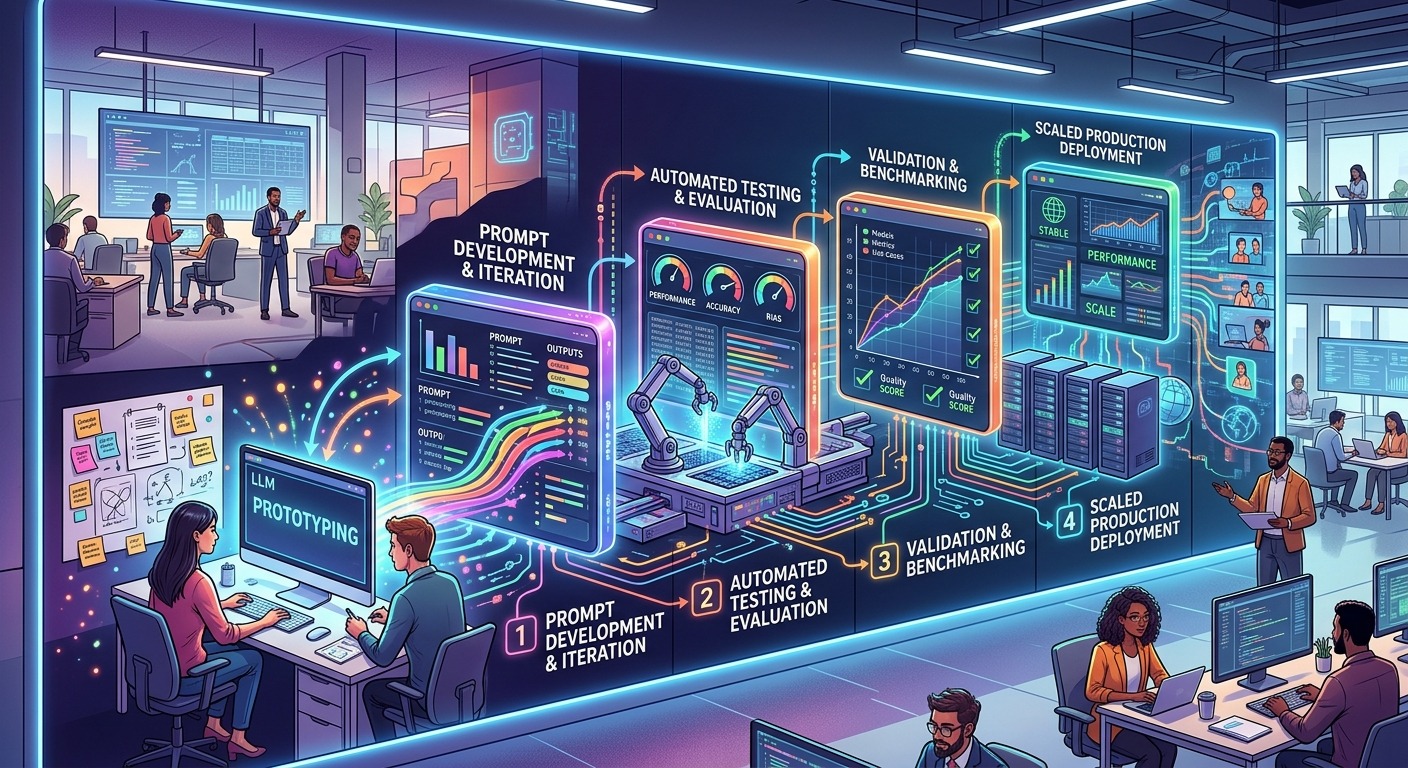
Most prompts don’t fail dramatically. They fail quietly. A model starts returning slightly off responses. Edge cases slip through. A phrasing change three weeks ago broke a classifier that nobody checked. By the time you notice, the damage is done and the cause is buried. The fix is not always more automation. It’s knowing when and how to test, from the first draft to the thousandth production request.
Structured testing at every phase is what separates prompts that hold up from ones that quietly degrade.
- Skipping early iterative testing is the root cause of silent prompt failures in production, not the absence of automation.
- Each phase (exploratory, structured, automated) demands different tooling and a different definition of what “good enough” means.
- Regression pipelines only protect you if quality test cases were built and validated in the earlier phases.
Why Prompts Break Silently Before Anyone Notices
The typical prompt engineering story goes like this. Someone writes a prompt, it works well in a demo, and it ships. Weeks pass. The model gets updated, or the input format shifts slightly, or a new use case sneaks in through user behavior. Nobody runs the original test again because there was no original test. There was just a demo that happened to work that day.
This is less a tooling problem and more a discipline problem. Teams reach for eval frameworks and automated pipelines before they have established what success looks like for a single input. The automation ends up testing nothing meaningful because the criteria were never defined. You cannot automate a standard you never wrote down.
The three-phase approach described here is built around one principle: you need to earn your way to automation. You cannot skip the messy, manual, iterative early work. That early work is where you learn what good output actually means for your specific use case. It’s the foundation everything else depends on.
Phase One: Rapid Exploration Before Committing to Anything
The first phase is about hypothesis testing, not production readiness. You are asking whether this prompt approach works at all. Can the model handle the kinds of inputs you will actually receive? What breaks first? What assumptions fall apart the moment inputs vary slightly?
The goal here is speed, not rigor. You want to try five different framing strategies, not run a formal eval on one. This is where low-friction tooling pays off. Starting with an AI chat interface lets you iterate on phrasing, tone, and instruction structure without setting up infrastructure or writing any code. The feedback loop is measured in seconds, not minutes, and that speed matters when you are still trying to figure out whether your approach is viable at all.
What you are building in this phase is intuition. You are learning how the model responds to ambiguity, how it handles edge cases you throw at it manually, and what kinds of instructions produce consistent structure versus freeform variation. This is not wasted time. It is the foundation that makes your later structured tests meaningful rather than arbitrary.
A common mistake is treating this phase as permanent. Developers fall in love with the chat interface and never graduate to structured inputs. Exploratory testing has a natural endpoint: when you have found a prompt approach that consistently handles your most important cases, it is time to move on.
Phase Two: Structured Evaluation with Parameterized Test Cases
The second phase is where most teams stumble. They understand that they need evaluations, but the implementation feels vague. The answer is simpler than most frameworks make it sound. You need a list of inputs, a way to run your prompt against each one, and explicit criteria for what a passing output looks like.
Parameterized test cases are the core of this phase. Instead of testing one prompt against one input, you define a dataset of representative inputs. These should include your most common cases, your known edge cases, and at least a few inputs that caused problems during the exploratory phase. Each input needs a corresponding expectation, whether that is a specific phrase in the output, a particular format, a classification result, or a factual answer you can verify against a known source.
Success criteria need to be explicit and machine-checkable wherever possible. “The response should be helpful” is not a criterion. “The response must contain a numbered list with exactly three items” is. “The output should be professional” is vague. “The output must not include first-person language” is testable. The effort you put into defining these criteria directly determines how useful your automated pipeline will be later.
This phase also introduces the practice of prompt versioning. Every time you modify the system prompt or the instruction template, treat it as a new version and run the full test suite against it. This turns ad-hoc edits into auditable changes and surfaces regressions before they reach users.
Federal guidance on AI evaluation standards consistently reinforces that systematic assessment of AI outputs requires documented criteria and repeatable processes, not just informal spot-checks. Structured evals are the mechanism by which intuition becomes evidence you can act on.
Phase Three: Automated Regression Pipelines for Production Stability
Once you have structured test cases and explicit criteria, automation becomes valuable. Before that point, you are automating noise.
A regression pipeline runs your prompt test suite on a schedule or as part of a CI/CD process. Whenever the underlying model changes, when you push a new prompt version, or when you add new test cases from production failures, the pipeline catches breakage early. This is standard regression testing applied to a non-deterministic system, which requires a few practical adaptations.
The first adaptation involves handling variability. LLM outputs are not deterministic. Running the same prompt twice can produce slightly different results. Your pipeline needs to account for this, typically by running each input multiple times and checking whether the output consistently meets criteria across runs rather than matching a fixed expected string.
The second adaptation addresses model drift. When a provider updates their model, behavior can shift even if you haven’t changed your prompt. A well-configured regression pipeline catches these shifts before they affect users, giving you time to adjust or revert. Without it, you find out from user complaints after the fact.
The third consideration is alerting. A pipeline that runs silently and produces a report nobody reads is not useful. The value comes from integrating results into your development workflow, attaching pass/fail status to deployments, and routing failures to the people who can act on them.
Prompt Testing Approaches Compared Across All Three Phases
| Phase | Primary Goal | Tooling | Signal for Moving On | Common Failure Mode |
|---|---|---|---|---|
| Exploratory | Hypothesis testing | Chat interface, notebooks | Prompt handles key cases consistently | Staying in this phase permanently |
| Structured Eval | Define and measure quality | Test datasets, eval scripts | Criteria-based pass/fail on full suite | Vague criteria that cannot be automated |
| Automated Pipeline | Catch regressions early | CI/CD integration, alerting | Failures surface before deployment | Pipeline output that no one acts on |
Turning Production Failures into a Better Test Suite
One of the highest-leverage habits in production prompt systems is converting every real failure into a test case. When a user reports a bad output, or when you catch an edge case in the wild, that input goes into your structured test suite immediately. This is called a bug-to-test workflow, and it is standard practice in traditional software engineering because it ensures you never regress on a real problem that already cost you something.
In an LLM context, this means capturing the full prompt context, including any injected variables or retrieved documents, alongside the specific output that failed. You document what went wrong and what the correct output should have looked like. Then you write a criterion that would have caught it. That criterion becomes a permanent part of your automated pipeline.
Over time, this approach builds a test suite that reflects the actual complexity of your real inputs rather than synthetic edge cases invented in isolation. It also creates a feedback loop between production monitoring and prompt development, which is the most reliable way to keep quality stable as your system scales and your user base grows.
Prompt Versioning as a Production Safety Net
Every production prompt system needs a version control strategy for the prompts themselves. This doesn’t mean you need a dedicated tool. It means that prompts should be treated as artifacts, not informal configuration values. They should live in source control, be tagged with version identifiers, and have associated test results that document how each version performed against the established criteria.
The reason this matters is rollback capability. When a new prompt version degrades quality, the ability to revert depends on knowing exactly what the previous version said. Teams that store prompts as hardcoded strings inside application code lose this ability entirely. A prompt stored in a repository with version tags and passing test suites attached gives you the same safety net you rely on for application code changes.
Prompt versioning also opens the door to A/B testing in production. If you can deploy two versions simultaneously and route traffic between them, you can compare real-world performance rather than relying entirely on offline evals. This matters because offline eval results and production behavior don’t always align, especially when the input distribution in your eval set doesn’t match what users actually send in real sessions.
The Discipline That Makes Automation Worth Running
The path from a working demo to a stable production prompt is a series of transitions, each requiring different tools, different mindsets, and different definitions of quality. Skipping the exploratory phase means you build structured evals around the wrong criteria. Skipping structured evals means your automation is testing nothing of substance. Skipping the pipeline means your hard-won test suite sits unused while production quietly degrades behind the scenes.
The teams that build reliable, scalable prompt systems don’t always have better models or bigger budgets. They have discipline around testing at each phase and the patience to earn automation rather than reach for it first. That discipline starts in a simple chat window, asking careful questions about what good output looks like for your specific task, and it ends with a pipeline that catches regressions before your users ever see them.
Automation is not the starting point. It’s the reward for doing the earlier work carefully.