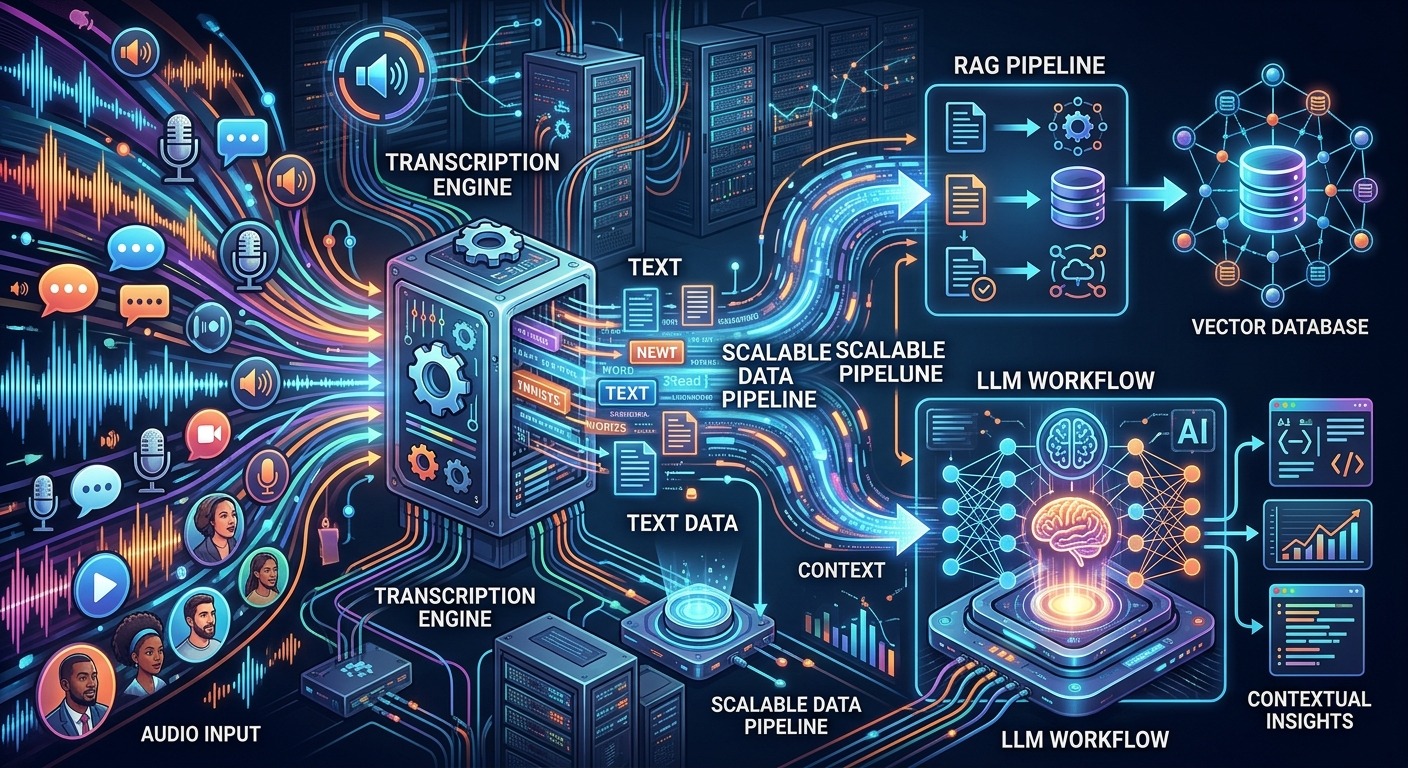
Most RAG implementations start with PDFs. That is a reasonable place to start, but it leaves an enormous amount of information on the table. Podcasts, customer calls, internal meetings, training videos, conference talks, recorded demos. All of that content exists as audio, and none of it is searchable until someone transcribes it. The teams that figure out how to process audio at scale end up with a retrieval corpus that most of their competitors simply do not have.
Pipeline Engineering Notes
- Transcription quality is not just an accuracy metric. It directly determines embedding quality and retrieval precision downstream.
- Chunking spoken content requires different heuristics than chunking written documents, and getting it wrong wastes your retrieval budget.
- Processing large audio backlogs before indexing is a distinct engineering problem that needs purpose-built tooling.
Why Audio Gets Skipped in RAG Implementations
Text is easy. You drop a PDF or a markdown file into a chunker, generate embeddings, and push them into a vector store. The tooling for that workflow is mature. Libraries handle it. The path is well-worn.
Audio is a different story. Before you can do anything with a recording, you need text. That means running a speech-to-text model, which introduces latency, cost, and a new failure mode. Teams look at that complexity and decide to come back to it later. Later usually never arrives.
The cost of skipping audio compounds over time. An organization that has been recording customer support calls for three years has a corpus of operational knowledge that could ground an LLM with real product context. Without transcription, that knowledge is inaccessible to any retrieval system.
Transcription Quality Propagates Downstream
This is the part that most teams underestimate. Transcription is not just a preprocessing step that gets out of the way once it runs. The quality of your transcripts sets a ceiling on everything that comes after it.
Consider what happens when a transcript contains errors. A speaker says “API rate limit” and the transcription model renders it as “a priori meta limit.” The embedding for that chunk now lives in a completely different region of your vector space. A query about rate limiting will not retrieve it. The information is there. It is just invisible to your retrieval system because the text representation is wrong.
This is why treating transcription as an afterthought is such a costly mistake. A 95% accuracy rate sounds good until you realize that a 5% word error rate across a 10,000-word transcript produces 500 corrupted tokens, and some of those tokens will be the precise technical terms your users are most likely to search for.
Choosing a Transcription Model for Your Use Case
The ASR landscape has shifted considerably in recent years. OpenAI’s Whisper established a new baseline for open-source transcription accuracy across multiple languages and acoustic conditions. Academic research on large-scale weak supervision for ASR demonstrated that training on diverse multilingual data substantially improves robustness to accents, background noise, and domain-specific vocabulary, even without labeled training data at the same scale as proprietary systems.
For most RAG pipeline work, you are choosing between three broad approaches. A locally hosted open-source model gives you control and no per-minute cost, but you need hardware to run it and you manage the infrastructure entirely. A managed API service trades cost per minute for zero infrastructure overhead and elasticity under load spikes. A specialized transcription service with domain tuning costs more upfront but produces dramatically better accuracy on technical, medical, or legal vocabulary.
The right choice depends on your volume, your accuracy requirements, and whether the domain vocabulary in your recordings matches what general models handle well. General models trained on internet audio tend to struggle with internal acronyms, product names, and highly technical jargon. If your recordings contain that kind of language, domain-specific approaches will pay for themselves in retrieval quality.
The Throughput Problem: Processing Audio at Scale
Most teams start with a real-time transcription mindset. A recording comes in, it gets transcribed, it gets indexed. That works fine for new content, but it does not address the backlog problem.
Almost every organization that decides to add audio to its RAG corpus immediately faces a backlog. Months or years of recordings that have never been processed. Processing these one at a time with a synchronous API call is not a viable strategy. A 40-hour backlog of call recordings, processed serially at real-time speed, takes 40 hours to complete. At 400 hours, the problem becomes obvious.
Batch processing at scale requires a different architecture. You want asynchronous job queues, parallel workers, retry logic, and a mechanism for tracking which files have been processed. Before pushing a large backlog of recordings into an embedding pipeline, teams often rely on bulk transcription services that handle this volume efficiently, producing clean text output that feeds directly into the indexing layer without requiring you to manage the infrastructure yourself.
The output format matters here too. Raw transcription output is usually a single block of text or a sequence of timestamped segments. For RAG, you need to make deliberate decisions about that structure before it reaches your chunker.
Chunking Spoken Content Is Not the Same as Chunking Documents
Written text has natural structure: paragraphs, sections, headers, sentence boundaries. Spoken content has different structure: speaker turns, topic transitions, pauses, and reformulations. Applying document-chunking heuristics to transcripts often produces poor-quality chunks.
Consider a podcast transcript. A speaker might spend three minutes on a single idea, interrupted occasionally by the other participant. A naive fixed-size chunker that splits on 512 tokens will cut through the middle of that idea, producing chunks that are contextually incomplete. A retrieval system working with those chunks will surface partial answers that frustrate users.
Several strategies work better for spoken content:
- Speaker-turn chunking: treat each speaker turn as a candidate chunk and merge short turns to reach a target token size
- Silence-based segmentation: use timestamp gaps in the ASR output to identify natural pauses and treat them as soft chunk boundaries
- Topic modeling before chunking: run a lightweight topic segmentation pass to identify where the conversation shifts and use those transitions as hard boundaries
- Sliding window with metadata: use overlapping windows and attach speaker, timestamp, and topic metadata to each chunk so the retrieval layer can filter and re-rank contextually
The right approach depends on your content type. Interview-style audio with two speakers responds well to speaker-turn chunking. Long monologues like lectures or presentations need topic-based segmentation. Customer support calls often have a predictable structure you can exploit with template-based chunking tuned to your specific call flow.
Metadata as a Retrieval Multiplier
Audio carries rich metadata that pure text documents rarely provide. Speaker identity, recording timestamp, duration, source channel (phone call, video conference, podcast), and acoustic properties can all be attached to your chunks at index time.
This metadata becomes genuinely powerful in a hybrid retrieval setup. A user query about “the product roadmap discussion from Q2” can be filtered by timestamp before vector search even runs, dramatically improving precision. Speaker metadata lets you build retrieval systems that answer questions like “what has the head of engineering said about latency?” without relying on the model to infer context from chunks alone.
The prerequisite is capturing that metadata at transcription time and propagating it through every subsequent step in the pipeline. Most teams drop metadata at the chunking stage because their chunking library does not support it natively. Building metadata propagation in from the start is much less expensive than retrofitting it after you have indexed thousands of hours of content.
Prompt Performance and the Transcript Quality Connection
A pattern that shows up consistently in production RAG systems is that retrieval quality directly predicts generation quality. The LLM can only work with what the retrieval layer surfaces. If your retrieved chunks contain transcription errors, filler words, incomplete thoughts, or misattributed speaker turns, those problems appear in the generated response.
Cleaning transcripts before indexing helps. Common cleaning steps include removing spoken filler words, standardizing technical terminology, correcting obvious transcription errors using a domain vocabulary list, and normalizing speaker labels. None of this is complex engineering, but it requires building the step into your pipeline rather than indexing raw ASR output directly.
The payoff is measurable. Cleaner chunks produce more precise embeddings, which improves retrieval ranking, which reduces the amount of irrelevant context your LLM has to reason through. That chain of effects shows up as shorter, more accurate, and more grounded responses across your application.
Putting the Transcription Layer at the Center of Your Pipeline
The teams that handle audio well treat transcription as a first-class pipeline concern, not a preprocessing quirk to deal with separately. That means designing your ingestion path with audio in mind from day one, selecting transcription tooling that matches your accuracy and throughput requirements, building metadata propagation into your chunking layer, and validating transcript quality before indexing rather than discovering retrieval failures in production.
The recordings your organization already has are a real asset. The operational knowledge in your customer calls, the product thinking in your internal meetings, the domain expertise in your recorded training sessions. All of it becomes searchable and retrievable once you build the pipeline to handle it. The transcription step is where that process starts, and getting it right is what determines whether the rest of your RAG investment actually pays off.