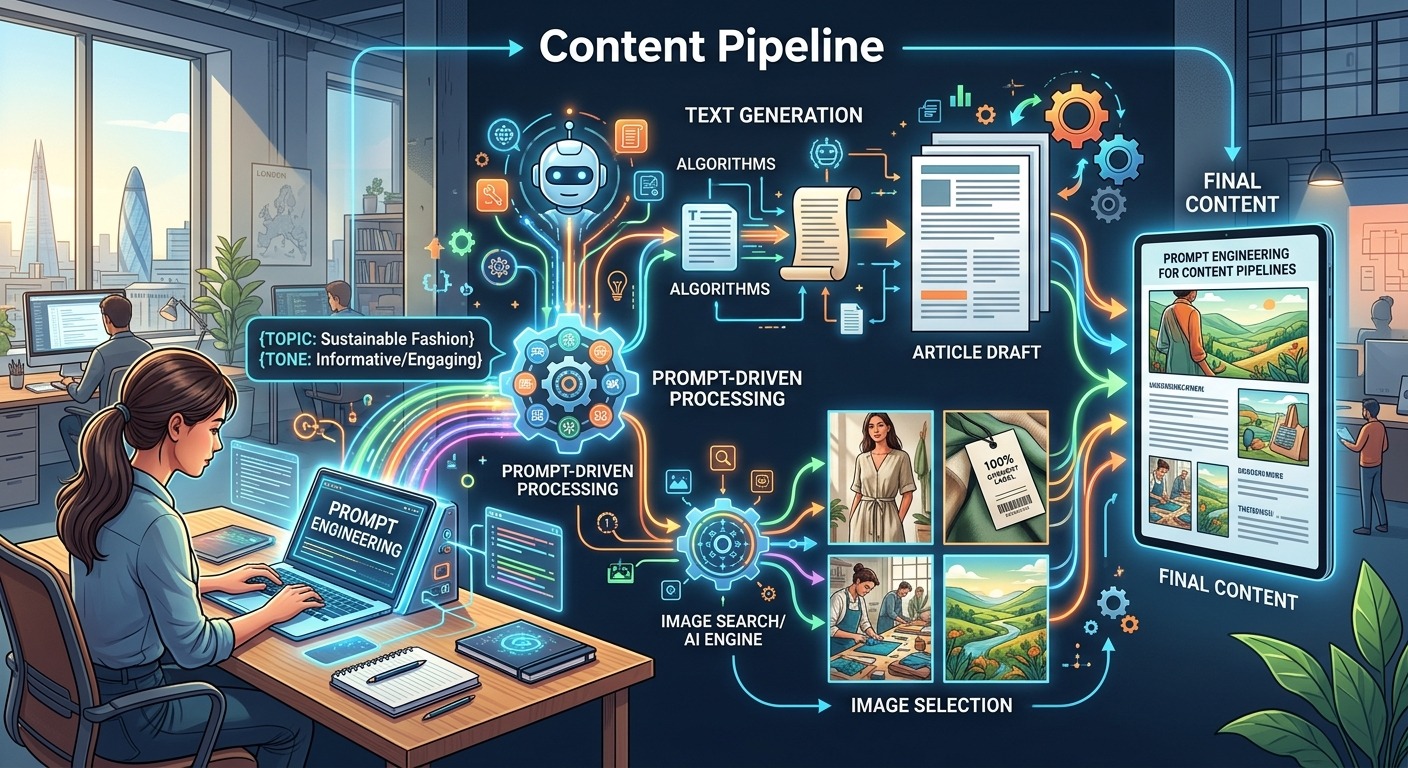
Most content pipelines fail quietly. The text looks fine. The pipeline runs without errors. But the images paired with that content are wrong. Wrong tone, wrong subject, wrong for the audience. The pipeline never complained because you never told it what good looks like.
Adding an image-selection stage to a content automation workflow is not just a technical challenge. It is a prompting challenge. Getting it right means thinking carefully about how you structure your prompts, what outputs you expect, and how you evaluate success when there is no single correct answer.
This article covers exactly that: how to build LLM prompts for multi-stage pipelines where one stage involves recommending, describing, or filtering image assets. This pattern is common in marketing automation, editorial publishing, and e-commerce content systems. It is also a pattern where vague prompts cost real money.
A well-structured image-selection stage does not happen by accident: it requires the same prompt discipline you apply to every other stage in your pipeline.
- Prompt chaining ensures your image stage receives structured context from upstream stages rather than starting from scratch on each call.
- Output schemas with rationale and risk fields make your pipeline’s reasoning auditable and failures easier to debug.
- Evaluating image-related LLM outputs requires human-calibrated rubrics because standard text metrics do not capture visual relevance.
Why Image Selection Complicates an Otherwise Predictable Pipeline
Text generation stages are relatively forgiving. You can evaluate output, compare it to a reference, and score it with established metrics. Image selection is different. The right image for a marketing email about enterprise software is not just semantically correct. It also needs to match brand tone, avoid licensing conflicts, suit the content’s emotional register, and work in a specific layout context.
When you ask an LLM to recommend images from a catalog, you are asking it to reason across multiple overlapping criteria at once. Without a structured prompt, the model optimizes for whichever criterion feels most salient in context, and that shifts between calls. The result is a pipeline that produces inconsistent output without any obvious error signal.
The fix is not a more powerful model. It is a more precise prompt architecture.
What a Multi-Stage Content Pipeline Actually Looks Like
A typical content automation workflow in marketing or publishing starts by ingesting a content brief or structured input object. From there it moves through outline generation, full text production, and then into the image selection stage before assembling the final packaged output.
Each stage owns its own prompt template. Each stage also produces output that feeds directly into the next. The image selection stage is almost always the most underspecified, because most teams get the text pipeline working first and treat image handling as something to bolt on later. That bolt-on approach is where quality problems accumulate.
The clearest architectural sign of a well-designed pipeline is that the image selection stage does not operate in isolation. It receives structured context from upstream stages rather than starting fresh with only the raw article body as input.
Passing Structured Context Into Your Image Selection Prompt
Prompt chaining is the foundation of any reliable multi-stage pipeline. For the image selection stage, chaining means passing a condensed context object at the top of the prompt rather than feeding in the full article text and expecting the model to infer what matters.
A minimal context block for an image selection prompt might look like this:
CONTENT_TYPE: marketing email
AUDIENCE: B2B SaaS buyers, senior decision-makers
TONE: confident, data-driven, not casual
SUBJECT: reducing infrastructure costs with containerization
CONSTRAINTS: no stock office imagery, no clip-art style graphics
With this block at the top of every image selection call, the model starts from a consistent, structured foundation. It is no longer inferring register or audience from prose. You are giving it the exact parameters it needs to make a relevant recommendation.
Writing the Recommendation Prompt Template
The recommendation prompt itself needs to ask for specific outputs. A prompt like “recommend an image for this article” is close to useless at scale. A structured template produces results you can actually process downstream:
You are an image curator for B2B content.

[CONTEXT BLOCK]

Given the above parameters, recommend the top 3 images from the catalog.
For each recommendation, return:
- image_id
- relevance_score (0.0 to 1.0)
- rationale (max 2 sentences explaining the match)
- risk_flag (licensing, tone, or audience concern, or null if none)

CATALOG:
[CATALOG ITEMS]
The rationale and risk_flag fields are the most important additions here. They make the model’s reasoning visible, which is what you need for both debugging and systematic evaluation.
Prompting for Captions and Alt Text
Caption generation is a separate task from image recommendation and needs its own prompt structure. Combining them into a single call is a mistake that produces output where the model trades caption quality for recommendation quality.
Caption prompts benefit from hard length and format constraints. “Write a caption for this image” produces variable, difficult-to-use output. “Write a caption in 10 to 15 words that describes what the image shows without restating the article headline” produces consistent, processable results.
For teams building their first image-oriented pipeline, taking time to learn about stock images before writing prompts around asset metadata is a practical step. The keywords and descriptions attached to stock assets are often the primary data your LLM will work from, and understanding their taxonomy shapes how you write your prompts.
Output Schemas That Keep Your Pipeline Consistent
Schema enforcement is what separates a pipeline that works once from one that works at scale. Free-form LLM output requires a parsing layer that can fail silently. Structured output matching a defined schema gives your downstream stages something predictable to process.
For image-related outputs, a solid schema pattern covers these core fields: an asset identifier string, a relevance score as a float between 0.0 and 1.0, a rationale string of one to two sentences, alt text formatted for accessibility, an optional caption, and a risk_flag that is either a brief concern string or null.
Defining your output contracts with structured output validation gives you a standard-backed way to enforce these shapes. When your pipeline validates every LLM response against the schema, you catch format drift before it reaches downstream stages and before it causes silent data quality problems in your content output.
Image Pipeline Stage Comparison
| Pipeline Stage | Prompt Focus | Key Output Fields | Evaluation Challenge |
|---|---|---|---|
| Image Recommendation | Multi-criteria scoring across tone, audience, and licensing | relevance_score, rationale, risk_flag | No ground truth; requires a human-calibrated rubric |
| Caption Generation | Length and format constraints, avoiding headline restatement | caption, alt_text | Brand voice alignment and factual accuracy |
| Image Filtering | Exclusion criteria and compliance checking | pass_fail, risk_flag, discard_reason | Calibrating compliance thresholds and edge cases |
How to Evaluate Image-Related LLM Outputs
This is where most teams stop short of doing systematic work. Image relevance feels subjective, and it is harder to automate than pure-text quality checks. That is not a reason to skip evaluation. It is a reason to build calibrated rubrics rather than relying on eyeballing output at the end of a sprint.
NIST’s AI evaluation guidance emphasizes defining quality criteria before building, not after encountering failures. That principle applies directly here. For image-related LLM outputs, a reliable evaluation framework focuses on these dimensions:
- Relevance to context: Does the recommended image match the content type, audience, and tone as defined in the context block? This can be partially automated using a separate LLM judge prompt, but human calibration of the rubric is required first.
- Rationale quality: Is the model’s reasoning in the rationale field coherent and specific? Vague rationale like “this image is professional” signals that the model was under-constrained.
- Risk flag accuracy: Are licensing concerns, tone mismatches, and audience issues being surfaced correctly? Evaluate this against a labeled test set of known problem assets.
- Schema compliance rate: What percentage of responses conform to the defined output schema without correction? Below 95% suggests your prompt needs stronger format instructions or few-shot examples.
Human evaluation at regular intervals is not optional for image pipelines. Even with a solid rubric and automated scoring on rationale quality and schema compliance, visual relevance requires a human judgment loop. The goal is to reduce how often that loop fires, not to eliminate it entirely.
Calibrating Your Prompts With a Labeled Test Set
Building a prompt once and deploying it is not a prompt engineering practice. It is a gamble. For image selection pipelines, calibration against a small, labeled test set is what moves you from guessing to measuring.
Start with 30 to 50 content briefs where you already know what a good image recommendation looks like. Run your prompt against these. Score each output against your rubric. Look at where the model’s relevance scores diverge from your human judgments. Those divergence points reveal where your prompt is missing a constraint or where your context block is underspecified.
Common calibration failures in image selection prompts include context blocks that omit negative constraints (what the image should not show), rationale fields that get satisfied by surface-level descriptions rather than genuine reasoning, and relevance score distributions that cluster near the midpoint, making ranking meaningless. Each of these has a prompt-level fix. None of them requires switching models.
Iteration cycles also tend to be faster than teams expect. A single pass through a 50-item test set, reviewed against a clear rubric, can surface two or three concrete constraint gaps. Fixing those gaps and re-running often closes 80 percent of the quality gap within two or three rounds.
Building Pipelines That Know What They’re Looking for
The image selection stage is not a problem you solve with a single clever prompt. It is a stage you design the same way you design any other part of a multi-step pipeline: with structured inputs, explicit output schemas, and a systematic approach to evaluating whether the output is any good.
That means passing structured context from upstream stages instead of raw article text. It means defining output schemas that include rationale and risk fields, not just asset identifiers. And it means building evaluation rubrics before you need them, not after you notice that your pipeline has been making poor image choices quietly for weeks.
The teams that get this right are not the ones with the best models. They are the ones who treat prompt architecture as an engineering discipline, apply the same rigor to image-related stages as to text generation, and build feedback loops that surface problems early. That is the only reliable path to a content pipeline that performs consistently at scale.