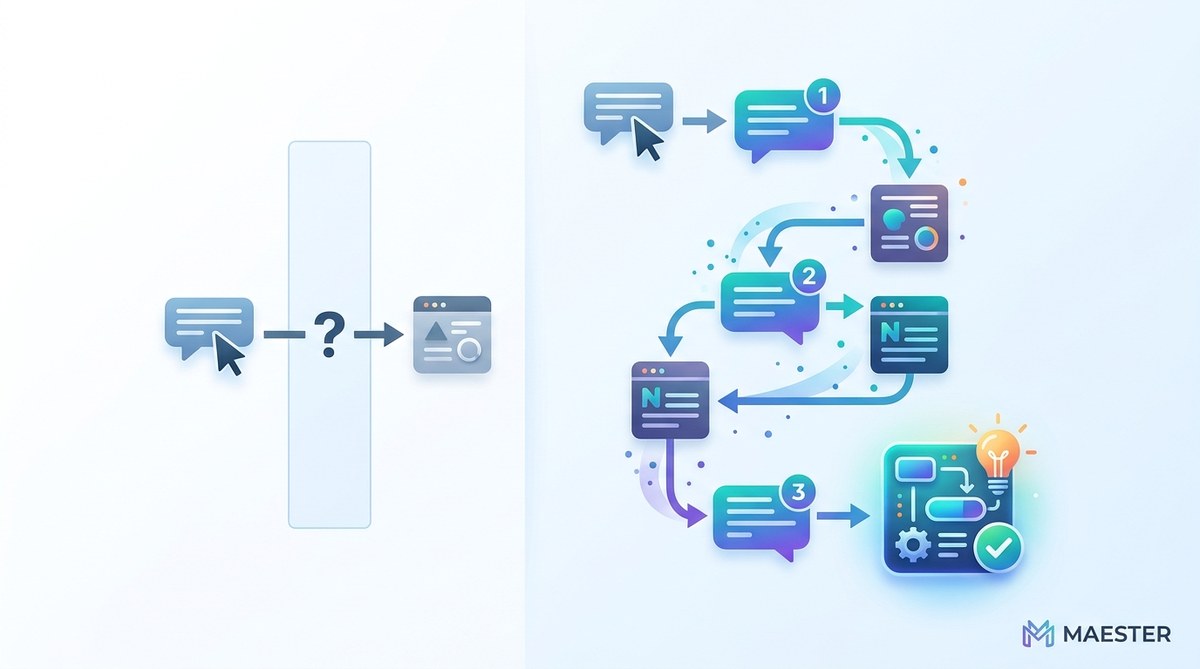
You sit down to write a detailed market analysis with your favorite LLM. You type a single, carefully crafted paragraph that asks for everything at once. The response comes back. It is okay, but it misses nuance. The structure is off. The tone does not match. So you start over. You try again. This cycle feels familiar to anyone who has pushed a language model past simple Q&A. There is a better way, and it does not involve cramming every instruction into one message.
Multi-turn prompting treats AI like a collaborator, not a vending machine. Instead of one giant query, you break work into steps, refine each output, and guide the model toward your goal. This method reduces errors, improves coherence, and gives you control over complex, multi-step tasks. Single queries are fine for simple questions. For real work, multi-turn wins every time.
Why a single query falls short for complex work
A single query asks the model to do too much in one pass. It must understand your goal, recall all the context you stuffed into the prompt, plan a structure, and generate text that meets every constraint. That is a lot of cognitive load for a transformer.
Think about what happens when you ask a colleague to write a full report in one go. They would need clarifications. They would ask about the audience, the tone, the key data points. A single query skips that conversation. It forces the model to guess.
Here is a common scenario. You want a blog post outline, a draft, and a set of social media snippets. A single query for all of that often produces a shallow outline, a draft that repeats itself, and social posts that do not match the article. The model runs out of attention budget.
Single queries also make debugging harder. If the output is wrong, you do not know which part of your instruction failed. Was the tone instruction ignored? Did the model misunderstand the data format? You have to rewrite the whole prompt and try again.
How multi-turn prompting changes the game
Multi-turn prompting flips the script. You start with a focused question or instruction. The model responds. You review, then ask for a revision or a next step. Each turn builds on the last. The model stays oriented because the context window fills with relevant, recent conversation.
This approach mirrors how humans actually work. You do not write a novel in one sentence. You outline, draft, edit, and polish. Multi-turn prompting applies the same iterative loop to your AI interactions.
For example, instead of asking for a full marketing plan, you might start with: “Give me three possible angles for a campaign about eco-friendly packaging.” The model returns three angles. You pick one and say: “Let us use angle two. Write a one-page strategy for that angle.” Then you follow up: “Now turn that strategy into a timeline for the next quarter.” Each turn is small. Each turn is precise.
The practical process: 5 steps to multi-turn mastery
Here is a numbered list you can use as a template for your next complex task.
- Define the first bite. Ask for something small and specific. A list of ideas. A single paragraph. A summary of a concept. Do not ask for the final output yet.
- Review and redirect. Read the response. Identify what works and what needs adjustment. Then give the model a clear instruction for the next turn. Use phrases like “Keep the tone from your last response but expand the second point.”
- Build incrementally. Add one layer of complexity per turn. First get the structure, then the content, then the formatting, then the polish. This keeps the model focused.
- Correct mid-course. If the model goes off track, you do not need to start over. Just say: “That is not quite right. Let me clarify. I need the data in a table instead of a list.” The model adjusts without losing prior context.
- Final review pass. Once you have the full output, do one final turn for consistency. Ask the model to check its own work for errors, tone mismatches, or missing details.
When to use each approach
| Use case | Single query | Multi-turn prompting |
|---|---|---|
| Simple fact lookup | Yes | Overkill |
| One-paragraph email draft | Yes | Possible but unnecessary |
| Multi-section report | Risky | Yes |
| Creative brainstorming | Works for one idea | Yes, for building on ideas |
| Code debugging | Sometimes | Yes, for step-by-step fixes |
| Data analysis with charts | Rarely works | Yes, for iterative refinement |
| Long-form content (2,000+ words) | Poor quality | Yes, for coherence |
| Learning a new topic | Shallow | Yes, for deep understanding |
The pattern is clear. Single queries handle quick, well-defined tasks. Multi-turn prompting handles everything that requires depth, iteration, or multiple components.
Common mistakes in multi-turn prompting
Even experienced users slip up. Here are the most frequent errors and how to avoid them.
- Losing the thread. You ask for a revision but do not restate the key context. The model forgets the original goal. Fix: periodically summarize the task in your own words. “Just to recap, we are writing a case study for a healthcare client.”
- Being too vague. “Make it better” is not a useful turn. The model does not know what better means. Fix: be specific. “Shorten the introduction to three sentences and add a statistic about patient wait times.”
- Skipping the review step. You get an output and immediately ask for the next part without checking the quality. Errors compound. Fix: read every response before sending the next prompt.
- Overloading a single turn. You start multi-turn but then cram three requests into one message. This defeats the purpose. Fix: one request per turn. If you need three things, that is three turns.
Expert advice from a prompt engineer with 4 years of experience: “The single biggest improvement you can make to your AI workflow is to stop treating the model like a search engine. Start a conversation. Each turn should feel like a natural follow-up question or instruction. If your prompt is longer than 200 words, you probably need to break it into multiple turns.”
Real example: Building a product launch announcement
Let me walk you through a concrete comparison.
Single query approach:
“Write a product launch announcement for our new SaaS tool called FlowSync. It helps project managers automate status updates. The audience is mid-level managers in tech companies. The tone should be professional but excited. Include a headline, three key features, a customer quote, and a call to action. Make it about 500 words.”
The model returns a generic announcement. The headline is boring. The features are vague. The quote sounds fake. You spend 20 minutes rewriting the whole thing.
Multi-turn approach:
Turn 1: “Give me five headline ideas for a product launch announcement for FlowSync, a tool that automates status updates for project managers.”
Model returns five headlines. You pick one.
Turn 2: “Use headline three. Write a short paragraph explaining the problem FlowSync solves. Focus on the pain of manual status updates.”
Model writes the problem paragraph. You like the tone.
Turn 3: “Now add three key features. Each feature should be one sentence followed by a short benefit. Keep the same tone.”
Model adds features. One of them is weak.
Turn 4: “Replace the third feature with this one: ‘Smart scheduling that learns your team’s reporting cadence.’ Rewrite that section.”
Model updates the feature.
Turn 5: “Write a customer quote that fits this announcement. Make it sound like a real project manager at a mid-size tech company.”
Model generates a quote. You tweak it slightly.
Turn 6: “Now write a call to action and a closing paragraph. Keep the total length around 500 words.”
The final output is cohesive, tailored, and required almost no editing. The process took six small prompts instead of one giant one that failed.
Why multi-turn prompting matters for your workflow in 2026
The AI landscape is shifting. Models are getting larger context windows and better reasoning. But the fundamental limitation remains: a single forward pass is a single chance to get everything right. Multi-turn prompting works with the model’s architecture, not against it.
For AI prompt engineers and technical content creators, this approach directly impacts productivity. You spend less time debugging bad outputs. You spend more time guiding the model toward exactly what you need. The quality of your final work improves because you can refine each component before moving to the next.
If you are building complex workflows, consider using tools that support multi-turn interactions natively. Platforms like Maester allow you to structure these conversations and save them as reusable templates. You can learn more about this in our guide on mastering prompt engineering for AI success.
Start your next task with a single question
The next time you face a complex AI task, resist the urge to write the perfect one-shot prompt. Instead, type one focused question. See what comes back. Then ask for the next piece. Treat the model like a capable assistant who needs clear, step-by-step direction. You will get better results, with less frustration, and you will actually enjoy the process.
Try it today. Open your chat interface. Pick a task you have been avoiding because it felt too big. Ask one small question. See where the conversation takes you.