<What Is a Prompt Compiler and Why Your AI Strategy Needs One in 2026
Managing prompts at scale feels like herding cats. You have dozens of variations. Different versions for GPT-4, Claude, and open-source models. Some prompts work. Others fail silently. And nobody has a single source of truth. This is where a prompt compiler comes into the picture. It is a tool that takes your raw prompt templates, applies rules and variables, and outputs production-ready prompts. Think of it as a build system for your AI interactions. Instead of copying and pasting text into a chat window, you define your prompts once, compile them for each use case, and ship them with confidence. In 2026, this is not a luxury. It is a requirement for any team that wants consistent, reliable AI outputs.
A prompt compiler is a system that transforms raw prompt templates into optimized, version-controlled prompts for different models and contexts. It eliminates manual copy-paste errors, enforces best practices, and lets teams manage prompts like code. For AI product managers, this means fewer broken outputs, easier A/B testing, and a clear audit trail. Without it, scaling AI workflows becomes chaotic and unreliable.
The core prompt compiler definition
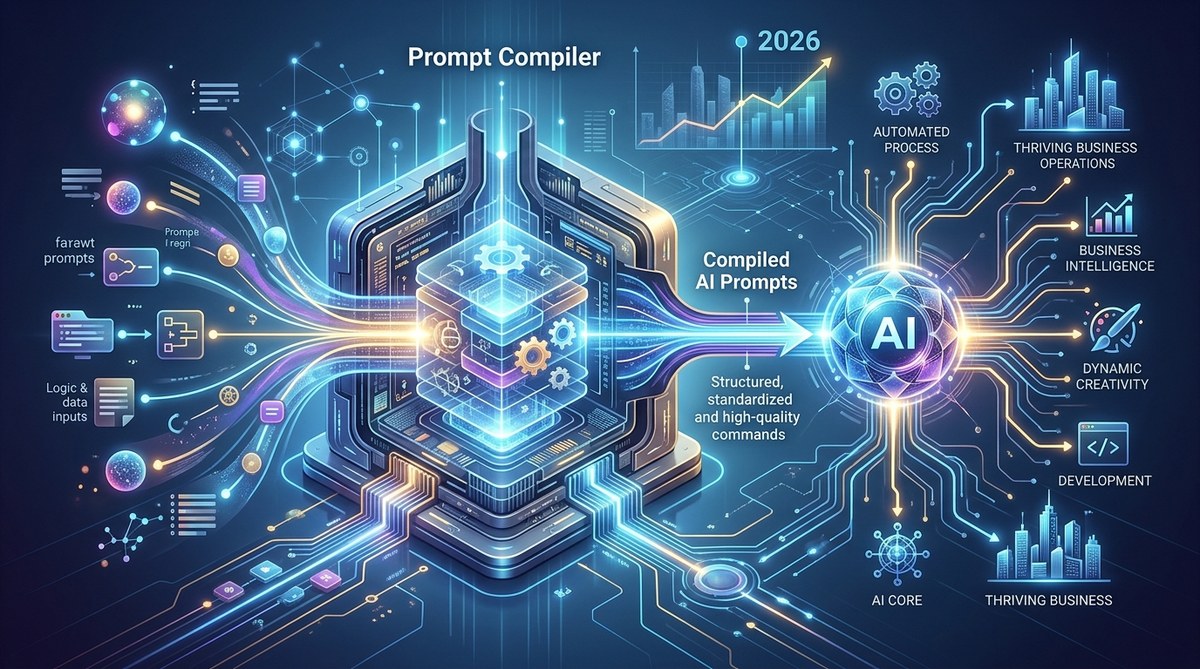
A prompt compiler is not a fancy text editor. It is a pipeline. You feed it a template with placeholders, and it fills in those placeholders with data from your system. It can also apply formatting rules, inject context, and switch between model-specific syntax. The output is a ready-to-send prompt that follows your team’s standards.
Here is a simple example. Your template might look like this:
You are a customer support agent for {company_name}.
The user's issue: {issue_description}.
Respond in a {tone} tone.
A prompt compiler takes the variables company_name, issue_description, and tone, and generates the final prompt. If you need to change the tone for a different channel, you update one variable instead of rewriting every prompt. This is the foundation of scalable prompt management.
Why your team needs a prompt compiler in 2026
The days of typing prompts into a browser tab are ending. Teams are building AI-powered features that require hundreds of unique prompts. Each one needs testing, version control, and monitoring. A prompt compiler gives you that control.
Consider the alternative. Your team has five engineers. Each one writes prompts in their own style. Some use few-shot examples. Others use chain-of-thought. When a model update breaks a prompt, nobody knows which version caused the issue. You waste hours debugging. A compiler enforces a standard structure. It logs every compiled prompt. You can roll back to a known good version in seconds.
For AI product managers, this is a game changer. You can run A/B tests on prompt variations without touching the codebase. You can measure which compile settings produce the best results. And you can onboard new team members without a long training period.
How a prompt compiler changes your workflow
Let us look at the practical steps. A typical workflow with a prompt compiler looks like this:
- Write your prompt template in a plain text file or a visual editor. Use placeholders for dynamic parts.
- Define your variables. These can come from user input, a database, or an API response.
- Set your compile rules. For example, add a system message for GPT-4, or format the output as JSON.
- Run the compiler. It generates the final prompt string.
- Ship the prompt to your AI model. Log the compiled version and the output.
- Iterate. Change the template or variables, recompile, and compare results.
This process turns prompt management from an art into an engineering discipline. You get repeatability. You get transparency. You get the ability to scale.
Common mistakes that a prompt compiler prevents
Many teams struggle with prompt quality because of simple errors. A prompt compiler catches these before they reach production.
| Mistake | How a compiler helps |
|---|---|
| Hardcoded model names in prompts | Uses variables so you can switch models without editing every prompt |
| Inconsistent formatting across team members | Enforces a standard template structure |
| Missing context or instructions | Validates required placeholders before compilation |
| Old prompt versions still running | Version control and rollback capabilities |
| Prompt injection from user input | Sanitizes or escapes user data during compilation |
These are the silent killers of AI output quality. A compiler acts as a safety net.
Building a prompt library that works
A compiler is only as good as the templates you feed it. That is why you need a well-organized prompt library. Think of it as a repository of your best prompts, each one compiled and tested.
Start by categorizing your prompts by use case. Customer support, content generation, data extraction, and so on. For each category, create a base template. Then create variations for different models or tones. Use the compiler to switch between them.
You can learn more about structuring your templates in our guide on how to build a prompt library that saves hours each week. It covers naming conventions, metadata, and testing strategies.
The shift from manual to automated prompt optimization
In 2025, many teams still optimized prompts by hand. They would tweak a phrase, test it, and repeat. That process is slow and subjective. In 2026, the best teams use automated tools to find the optimal prompt configuration.
A prompt compiler integrates with these optimization tools. You define a set of variables and let an algorithm test different combinations. The compiler handles the heavy lifting of generating each variant. You just evaluate the results.
This is part of a larger trend. The shift from manual prompt design to automated optimization in 2026 is real. Teams that adopt it first will have a significant advantage.
“A prompt compiler is the missing link between prompt engineering and software engineering. It brings the same rigor to AI prompts that version control brought to code.” – Lead AI Architect at a Fortune 500 company
What to look for in a prompt compiler
Not all compilers are equal. Here are the features that matter most for enterprise teams:
- Template syntax: It should support variables, conditionals, and loops. Your prompts will get complex.
- Model adapters: The compiler should know how to format prompts for different models. GPT-4 uses a different structure than Claude.
- Version control integration: It should work with Git or your existing CI/CD pipeline.
- Testing hooks: You need to run automated tests on compiled prompts before they go live.
- Audit logging: Every compiled prompt should be logged with a timestamp and version number.
If a tool lacks these, it is not ready for production use.
Putting it all into practice
You do not need to overhaul your entire AI stack overnight. Start small. Pick one use case that is causing you pain. Maybe it is your customer support chatbot. Maybe it is your content generation pipeline. Write a template for that use case. Set up a simple compiler. Run it for a week. Measure the difference in output quality and team velocity.
Once you see the improvement, expand to other use cases. Before long, your entire AI operation will run on compiled prompts. You will wonder how you managed without it.
For more on this topic, check out our article on how to use prompt templates to scale your AI workflows. It walks through a real-world example of a team that made the switch.
The future of prompt management is compiled
A prompt compiler definition is simple, but its impact is profound. It moves your team from ad-hoc prompt writing to a structured, repeatable process. It gives you control over your AI outputs. It saves time, reduces errors, and makes your AI strategy scalable.
In 2026, the teams that treat prompts as code will outperform those that treat prompts as chat messages. The compiler is the tool that makes that shift possible.
Try it with one prompt today. See the difference for yourself.